An Environmental Impact Assessment (EIA) is the process by which the anticipated effects on the environment of a proposed development or project are measured. EIAs can be undertaken for individual projects or for public plans, in order to ensure that plans likely to have significant effects on the environment are made subject to assessment prior to their approval or authorization. If the likely effects are unacceptable, design measures or other relevant mitigation procedures can be taken to reduce or avoid adverse effects.
The United Nations Environment Program defines EIA as a tool used to identify the environmental, social and economic impacts of a project prior to decision-making. It aims to predict environmental impacts at an early stage in project planning and design, find ways and means to reduce adverse impacts, shape projects to suit the local environment and present the predictions and options to decision-makers. By using EIA, both environmental and economic benefits can be achieved, such as reduced cost and time of project implementation and design, avoided treatment/clean-up costs and impacts of laws and regulations.
The intention of Environmental Impact Assessments aim to provide a high level of protection for the environment and to contribute in the integration of environmental considerations into the preparation of projects, plans, and programs with a view to reduce their environmental impact and create sustainable infrastructure for our cities.
EIAs are crucial for ensuring sustainable development and creating cities that are manageable for our future generations.
Although legislation and practice vary, the fundamental components of EIA typically involve the following stages according to the Convention on Biological Diversity:
- Screening to determine which projects or developments require a full or partial impact assessment study.
- Scoping to identify which potential impacts are relevant to assess (based on legislative requirements, international conventions, expert knowledge and public involvement), to identify alternative solutions that avoid, mitigate or compensate adverse impacts on biodiversity (including the option of not proceeding with the development, finding alternative designs or sites which avoid the impacts, incorporating safeguards in the design of the project, or providing compensation for adverse impacts), and finally to derive terms of reference for the impact assessment.
- Assessment and evaluation of impacts and development of alternatives, to predict and identify the likely environmental impacts of a proposed project or development, including the detailed elaboration of alternatives.
- Reporting the Environmental Impact Statement (EIS) or EIA report, including an environmental management plan (EMP), and a non-technical summary for the general audience.
- Review of the Environmental Impact Statement (EIS), based on the terms of reference (scoping) and public (including authority) participation.
- Decision-making on whether to approve the project or not, and under what conditions; and
- Monitoring, compliance, enforcement and environmental auditing. Monitor whether the predicted impacts and proposed mitigation measures occur as defined in the EMP. Verify the compliance of proponent with the EMP, to ensure that unpredicted impacts or failed mitigation measures are identified and addressed in a timely fashion.
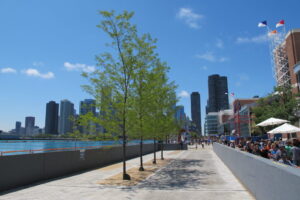
That’s why street trees can be a critical part of Environmental Impact Assessments. Find out more about The Importance of Urban Trees in Stormwater Management in another blog article.