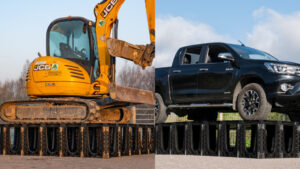
There are many aspects that need to be taken account of when planting trees in urban areas – one essential factor being soil compaction. It is important to determine site environment and soil conditions in order to mitigate the constraints of compacted soil and create healthy tree planting conditions.
In previous blog posts, we have detailed the soil requirements of healthy trees and the amount of soil urban trees should have. Now, we discuss soil compaction and why uncompacted rooting volume is so critical to the health of street trees.
Once site assessment has been completed, it is critical to correlate the conceptual design intent with physical site conditions, to determine the limitations and opportunities of any given site. Many potential urban soil limitations can be addressed with specie selection – such as spatial constraints, soil PH, cold hardiness, wet & dry soil conditions, sun & shade patterns, and even salt contamination. One soil condition that cannot be mitigated by plant selection however, is soil compaction. Compacted soil that can’t be penetrated by tree roots is as useful as no soil at all. If these conditions are found to be the case during site assessment, suitable steps to modify the soil must be taken.
Soil compaction is a reduction in large pore space which reduces soil oxygen levels and decreasing soil drainage. As a result, rooting depth is reduced. According to Colorado State University, soil compaction is the most common factor leading to the decline process of trees. At very least, compacted soil results in stressed plants that are more likely to suffer from secondary problems such as diseases and insect pests.
Soil compaction is the most prevalent of all soil constraints on urban tree growth. Every place where humans and machines exist, and the infrastructures that support them are built, soil compaction will be present. There are few soil areas without some form or extent of soil compaction. Compacted soil has become a fact of life for urban trees.
Avoiding Soil Compaction
Soil support cells, and before that ‘structural soil’ have been devised to address this dilemma of allowing uncompacted soil for the trees, while providing durable stability for roads and paved surfaces to be built.
Early methods focused on a rock and soil mixture, known as structural soil, to provide pavement support, while attempting to permit some root growth beneath the pavement. Since then, structural soil cells have moved this principle forward by replacing the rock, which had accounted for 80% of total volume, with engineered modules that only account for 6% of volume.
Structural soil cells are modular units that assemble to form a skeletal matrix, situated below pavement level, to support the pavement load while providing large volumes of uncompacted soil for root growth within the matrix structure.
Various soil cell designs are available on the market providing over 94% void space for soil and root growth. Different designs address the need for strength while maximizing available space for roots as well as for common conduits and utilities.

Industry professionals are increasingly insisting on the use of soil cells for tree plantings on streetscapes and other paved areas. They recognize that while soil cell technology builds upon earlier structural soil concept, it is clearly superior in performance. Not only is vastly more soil made available to the tree, installation is straight forward and avoids the need of extensive calculations and testing required for the use of structural soil.
GreenBlue soil structure systems, such as StrataCell, safeguard that all important root zone, keeping the load off the soil, and keeping the soil open and free draining – giving trees a real long term future – for the benefit of generations to come.