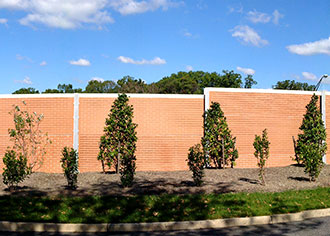
Although built infrastructure of all kind is necessary for our cities and daily lives, it often isn’t something we enjoy looking at. And as the Fairfax County residents on Stevenson Avenue faced, the prospect of a 15 foot brick wall immediately across the street from their front door wasn’t something they were particularly pleased with. But, with a little ingenuity and the right system, the architects of this project were able to turn the construction of a potentially controversial sound barrier along a major highway into a functional, aesthetically pleasing design statement.
Interstate-95 is the main highway on the east coast of the United States, running north-south from the Canadian border to the south of Florida. It is one of the busiest highways in the USA servicing up to 500,000 vehicles per day. But along with those highway commuters comes noise – and a lot of it.
Last year, the Virginia State Department of Transportation erected a new sound barrier wall to mitigate the noise generated in the suburban areas from the I-95 (I-395) that passes through the cities of Alexandria and Springfield in Fairfax County, Virginia. Along with the sound barrier, was the proposal of approximately 50 new tree plantings to line the residential street of Stevenson Avenue, which runs parallel to the interstate. This provided an excellent opportunity to soften the visual impact of the barrier.
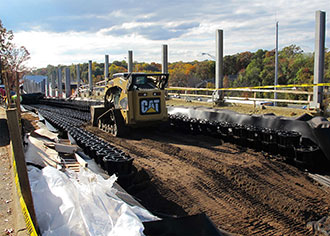
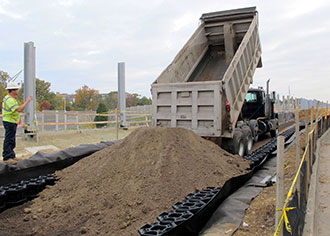
“The client wanted a structural planting area to provide a growing zone for the trees that were going to be planted right next to the sound barrier,” explained the GreenBlue consultant that oversaw the project. “StrataCells® were used to support the integrity of the planting zone and prevent settlement of the surrounding areas into the planting zone.”
Root management was also a concern. For engineering reasons, the client wanted to prevent the tree roots from encroaching into the reinforcing areas of the sound barrier. Therefore, RootStop root barriers were incorporated around the planting zone to ensure roots were kept in the designated StrataCell® rooting space and away from the structural reinforcing areas of the barrier.
GreenBlue supported in the design and installation of the project, and worked onsite with RSG Landscaping, the landscape contractor, to provide installation accreditation and ensure the correct utilization of the ArborSystem® components. “The installation went well and the engineer and contractor had a good understanding of the benefits that ArborSystem® provides,” the GreenBlue project consultant explained. He added that the contractor was very impressed with the structural capabilities of the StrataCell® modules.