One of the biggest challenges the landscaping industry face today is how we effectively combat the current crisis of climate change. Most importantly how we can align collectively to enable an integrated approach to consider both mitigation and adaption to reduce emissions and stormwater, support the heat island effect and above all reduce global warming.
The crisis is clear – it is happening now, as landscaping professionals, we are all here to make our built and natural environment a better place for all.
At GreenBlue Urban our work is based on a firm passion for the planting and nurturing of healthy, thriving trees. We lead the way in creating places with cleaner air, sustainable drainage, pleasant appearance and more diverse wildlife. Our role is an important one – satisfying clients, users and environmental concerns in equal measure.
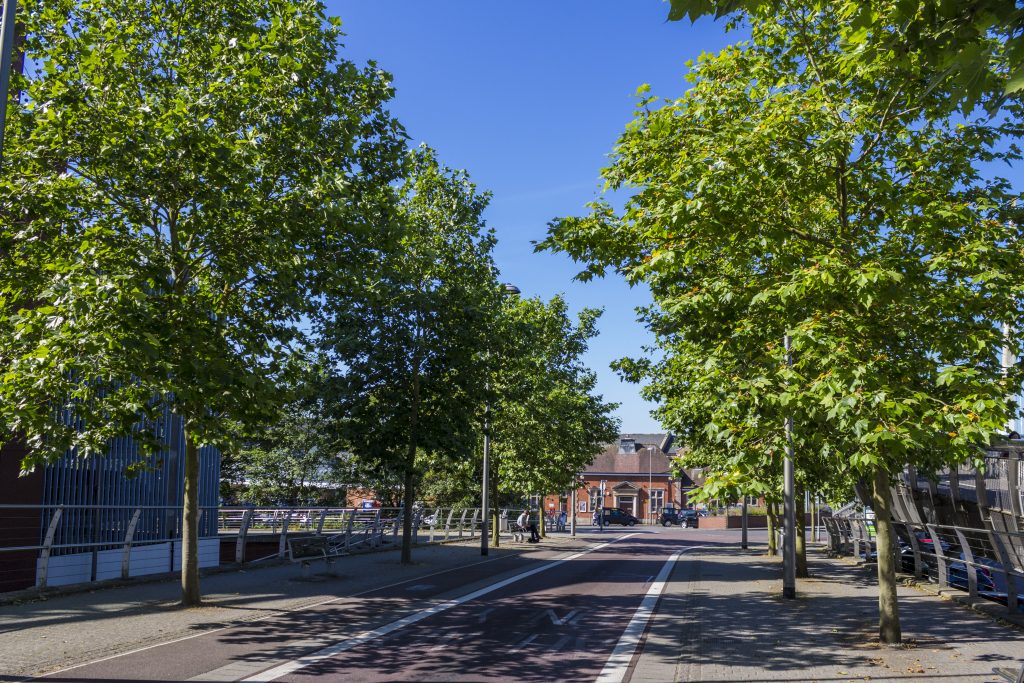
In the lead, up to COP 26 our aim is to educate and inspire for the long term. Of course, the planners and clients with whom we work are also keen to see trees given the presence they deserve in our projects. But we know that planting a tree is just the start. For a tree to live its best life as part of an urban ecosystem, it must be installed in a way that will support its growth and enable healthy development.
Challenging compromises
But it’s not easy, is it? Our profession is full of tensions. As landscapers and specifiers, we want to create urban environments that are functional, attractive and sustainable, where trees are celebrated and allowed to thrive. Yet competing with these goals are issues of cost and space. These concerns are often significant. Our challenge is to champion the presence of healthy long-lived trees while ensuring our colleagues and collaborators understand the need to invest in high-quality design and attention-to-detail.

Comparing the alternatives
One of the questions we are most frequently asked is ‘Can I get away with a cheaper alternative?’ We understand why. And it can be a difficult question to answer. The popularity of affordable planting media like sand, structural soil and compacted raft systems often tempts clients or quantity surveyors to cut corners when it comes to tree planting. We have unfortunately seen the consequences of other systems
But is there a risk of a false economy? Within complex designs, where the long-term health of trees deserves to be taken seriously, those planted using GreenBlue Urban ArborSystem components – including RootSpace pavement support systems, (commonly known as soil cells) have been found to out-perform traditional alternatives when it comes to drainage and aeration. And in the long run, that performance means money is saved.
Why replace trees before their prime when you don’t need to?
Landscaping professionals specify and plant trees for the benefits they bring to our built environment. Unhealthy trees, withered and replaced before they reach maturity, never grow to a point where their real benefits are realised. GreenBlue Urban’s studies show that in many cases when trees are constantly replaced in a poorly-designed environment, the hoped-for benefits of a green tree-rich environment never materialise.

Replacement of unhealthy trees wastes money
Over an extended period of time, unhealthy urban trees must be replaced. Furthermore, a new tree, in the same substandard conditions as its predecessor, is doomed to the same fate. The expense of repeated replanting eventually mounts, while an initial investment in high-quality planting is a one-off cost that pays for itself through the long life of the healthy tree.
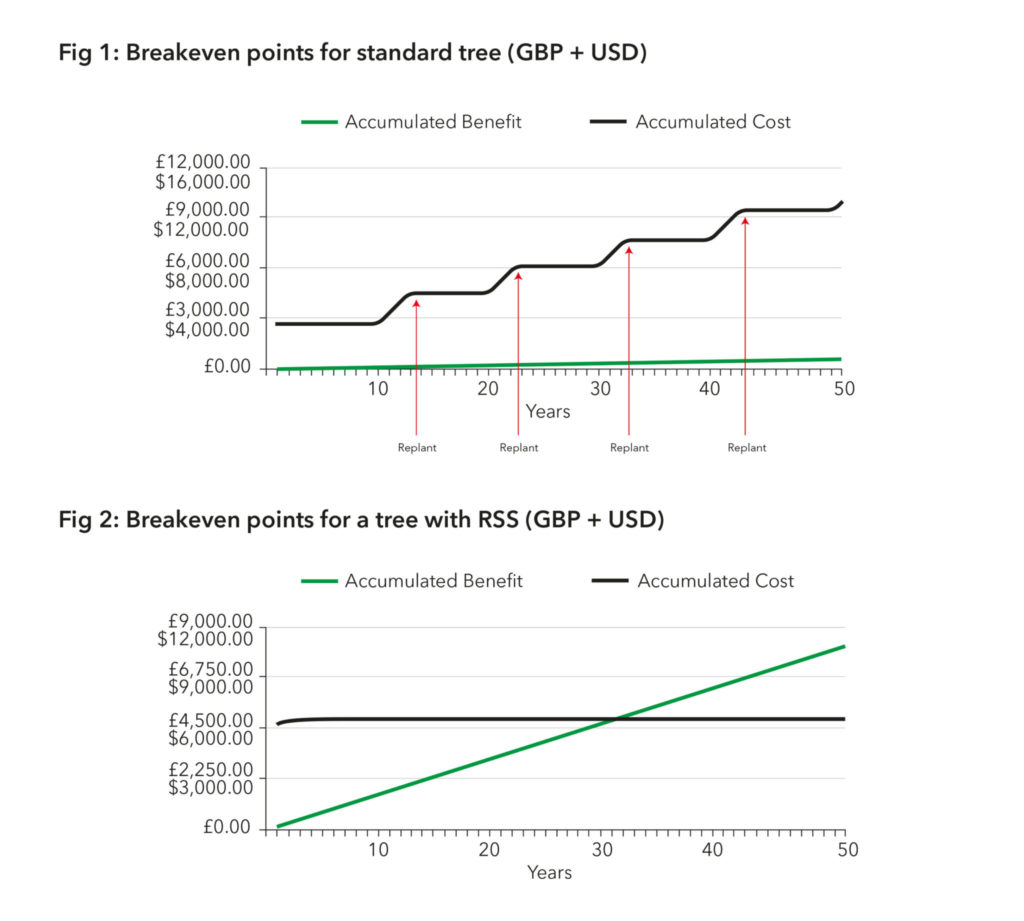
GreenBlue’s collaboration with Treeconomics enabled a detailed look at the long-term economics of repeated tree replacement. As with any significant project, a breakeven point is reached after several years, where the numerous benefits of a tree begin to exceed its initial cost. But in locations where the cost of replacement becomes an ongoing necessity, the breakeven point is sometimes never reached at all, as the costs keep mounting, and the benefits never materialise.
Calculating the long-term savings
We took a 50-year view of the situation, reflecting the long-term view that comes so naturally to the landscaping profession.
When all was calculated, the repeated replacement cost of a poor-quality tree installation brings developers and clients a loss of around £12k per tree.
A GreenBlue Urban installation, on the other hand, is specified for the long term, meaning that not only are costs saved, but quantifiable benefits are really allowed to show themselves on a project’s balance sheet. There is a net long-term benefit approaching £3k per tree.
An investment that pays for itself
Landscapers and project managers increasingly tell us that by taking tree health seriously at the design stage, the concerns of clients, local authorities and environmental bodies are satisfied not just in the short term, but several years down the line. Trees planted with GreenBlue Urban ArborSystem products are seen to thrive – along with the professional reputations of everyone involved.
Helping you make the case for healthy trees
So how can GreenBlue Urban help? When it comes to making the case for best-practice design, our technical specialists are on hand to help streamline the specification process and build understanding.
Make a start by downloading our Street Tree Cost Benefit Analysis, showing exactly how the science and economics combine to make a clear case for investing in healthy urban trees.